The Hidden Cost of Intelligence: Data Centers, Behavioral Economics, and Climate Policy
Frames the energy demands of AI data centers as both an environmental externality and a behavioral problem, and proposes a three-pillar accountability plan of disclosure, a graduated fee and conditional renewable procurement.
Abstract
The rapid expansion of artificial intelligence data centers has created a new energy-policy challenge: electricity demand has been rising faster than existing voluntary and public commitments and disclosure systems can manage. Demand for electricity, in the United States and the world, has skyrocketed to unforeseen heights, where voluntary corporate commitments and partial regulatory firm structures have demonstrably failed to constrain it. Drawing from Daniel Kahneman and Amos Tversky’s prospect theory and Richard Thaler and Cass Sunstein’s model of libertarian paternalism, the paper frames the AI data center energy crisis as an amalgamation of environmental externalities and behavioral distortions. Specifically, present bias, optimism bias, and status quo bias are what prevent currently existing corrective tools from operating at a scale necessary to address the sector’s accelerating energy consumption. Using data from the International Energy Agency (IEA), Lawrence Berkeley National Laboratory, and recent policy examples, this analysis evaluates three policy options: a carbon tax, a renewable procurement standard, and mandatory disaggregated energy disclosure. Ultimately, we recommend a three-pillar AI Data Center Energy Accountability Plan, achieving a policy complementarity that single-instrument interventions cannot, combining a (1) facility-level disclosure, a (2) graduated fee for underperformance, and a (3) conditional renewable energy procurement requirement.
I. Introduction
In 2025, five of the largest American technology firms — Alphabet, Amazon, Meta, Microsoft, and Oracle — committed over $300 billion to AI infrastructure globally. This sum was greater than twenty percent of the total power sector investment in the United States.1 The facilities that this capital is constructing will draw electricity continuously over operational lifespans of fifteen to twenty years. The same firms have publicly ‘pledged’ to reach net-zero or carbon neutrality between the years 2030 and 2040, commitments that their own sustainability reports characterize as central to their corporate identity. However, these were unachievable targets in a peer-reviewed scenario model in Nature Sustainability.2 Standard environmental economics would identify data-center electricity consumption as a negative externality and would typically recommend a Pigouvian tax or similar pricing mechanisms to internalize the social costs of emissions. This, to an extent, is partially valid. The carbon and water costs of data center expansion are largely borne by people other than the firms operating the facilities. Increased electricity demand places strain on the grid, resulting in higher costs for consumers; intensive water usage affects local communities; and long-term climate consequences of carbon emissions are passed down to future generations. But no such carbon tax specifically applies to U.S. data center electricity consumption. The Environmental Protection Agency’s (EPA) Greenhouse Gas Reporting Program (GHGRP) — the federal regulation that tracks industrial emissions — does not classify data centers as a covered source category. Thus, the program excludes indirect emissions from purchased electricity from its reporting requirements.3 Other potential mechanisms, including a 2024 federal rule that would’ve required publicly traded operators to disclose their emissions to investors and the European Union’s mandatory data center reporting regime, have either failed to take effect or do not yet reach U.S. firms.4 The question the paper takes up is why these corrective tools have yet to prove themselves effective.
In its entirety, this paper sees the energy problem created by AI data centers not solely as a negative externality but as a behavioral policy failure. Because the biases of behavioral economics — present, optimism, and status quo (which will be further explored in the following section) — distort how firms, investors, and regulators perceive the problem, we view the most effective policy to be one that accounts for a mandatory disaggregated energy disclosure, a graduated fee for underperformance, and a conditional renewable procurement requirement.
II. Theory Foundation
The standard economic theory — coined as a neoclassical or mainstream concept — rests on the assumption that individuals are rational agents who, when faced with a choice, will gather accessible information, conduct a strengths-weaknesses-opportunities-threats (SWOT) analysis, and select the option that maximizes their utility. This stereotypical model of the ‘rational actor’ is viewed as elegant and scientifically tractable, but it describes almost no one. The behavioral economics tradition initiates a different premise: human cognition is limited, whereby decisions are shaped based on the structure of the environment in which they are made, and these limitations are not random but systematic and, hence, predictable.
Dating back to the field’s intellectual origins lies the collaborative work of psychologists Daniel Kahneman and Amos Tversky, whose 1979 paper introducing prospect theory demonstrated experimentally that people evaluate outcomes not in terms of final wealth but relative to a reference point, and that losses feel approximately twice as painful as equivalent gains feel rewarding.5 This unequal psychological weighting of losses and gains, also known as loss aversion, produces a set of predictable biases. People preferably cling to the status quo because change feels like a loss, even when it may produce a net gain. As a result, they tend to focus too much on immediate costs and too little on future ones. In this sense, Kahneman and Tversky’s prospect theory helped explain why decision-makers systematically deviate from the predictions of standard rational-choice models. People therefore apply different standards of reasoning depending on how a choice is framed, even when the options are mathematically identical.
The policy implications of bounded rationality were most fully developed by Richard Thaler and Cass Sunstein in their 2008 theory of libertarian paternalism. Their claim was that every choice is made within a designed environment, and because that specific structure of the environment strongly dictates people’s behavior, there is no neutral way to present options.6 Every default setting, informational display, and order of choices all shape behavior, and that behavior either works deliberately in people’s interest or works against it by accident. Thaler and Sunstein proposed that policymakers should design choice environments intentionally, using tools like default restructuring, social norm salience, and timely feedback to guide decisions toward better outcomes without restricting anyone’s freedom to choose otherwise. They defined this as a nudge.7
There are three specific mechanisms within this framework that are relevant to the prevalence of data centers. Firstly, present bias encourages firms to prioritize immediate AI infrastructure expansion over long-term environmental costs, even when the future costs are substantially larger in expected value terms. The second is optimism bias, where firms overestimate the credibility of future decarbonization plans, causing them to discount the probability of negative long-run outcomes. And lastly, status quo bias: the preference for existing arrangements over alternatives, reinforced by aggregated reporting systems that conceal AI-specific energy use. When these biases operate concurrently within a corporate decision-making environment, as they do in the technology sector’s approach to energy infrastructure, a ‘behavioral market failure’ occurs through the cognitive decisions that firms make and not due to physical or technological constraints. No single firm has the incentive to correct itself unilaterally since doing so would result in an instant competitive disadvantage: slowing AI infrastructure expansion would cede market share to rivals who do not, while still bearing only a fraction of the social cost its competitors continue to generate. Each firm’s rational response, consequently, is to mirror the bias rather than to break apart from it.
This makes the case for why behavioral economics best addresses the data center problem. The failure is not a result of insufficient information or a stated intention; virtually every major technology firm has the human capital to identify the necessary information and has issued net-zero pledges. It is a failure to translate climate commitments into actual decision-making because the environment in which energy and infrastructure choices are made rewards short-term competitive logic and renders long-term environmental costs psychologically remote. To confront this behavioral diagnosis, it calls for a behavioral remedy.
III. Case Study & Sector Analysis
For most of the first two decades of the twenty-first century, the data center industry maintained what most now, in retrospect, would call a remarkable achievement: electricity consumption in the U.S. stayed roughly stable even as the volume of global computing usage expanded dramatically, hovering between sixty and seventy terawatt-hours annually without any spikes.8 This productivity management proved practical because improvements in server efficiency, cooling systems, and data center design kept pace with rising demand.9 Around 2017, however, that equilibrium began to shift when the arrival of AI workloads began to necessitate qualitatively different computational infrastructure; precisely, the dense, energy-intensive graphics processing unit (GPU) clusters that large language models (LLMs) and others depend on.10 By 2023, U.S. data center electricity consumption had climbed to around 200 terawatt-hours annually, which is three times the flat-efficiency level just six years earlier. Consequently, the once sturdy trend line morphed into a steeper growth trajectory, and demand has been rising quickly ever since.
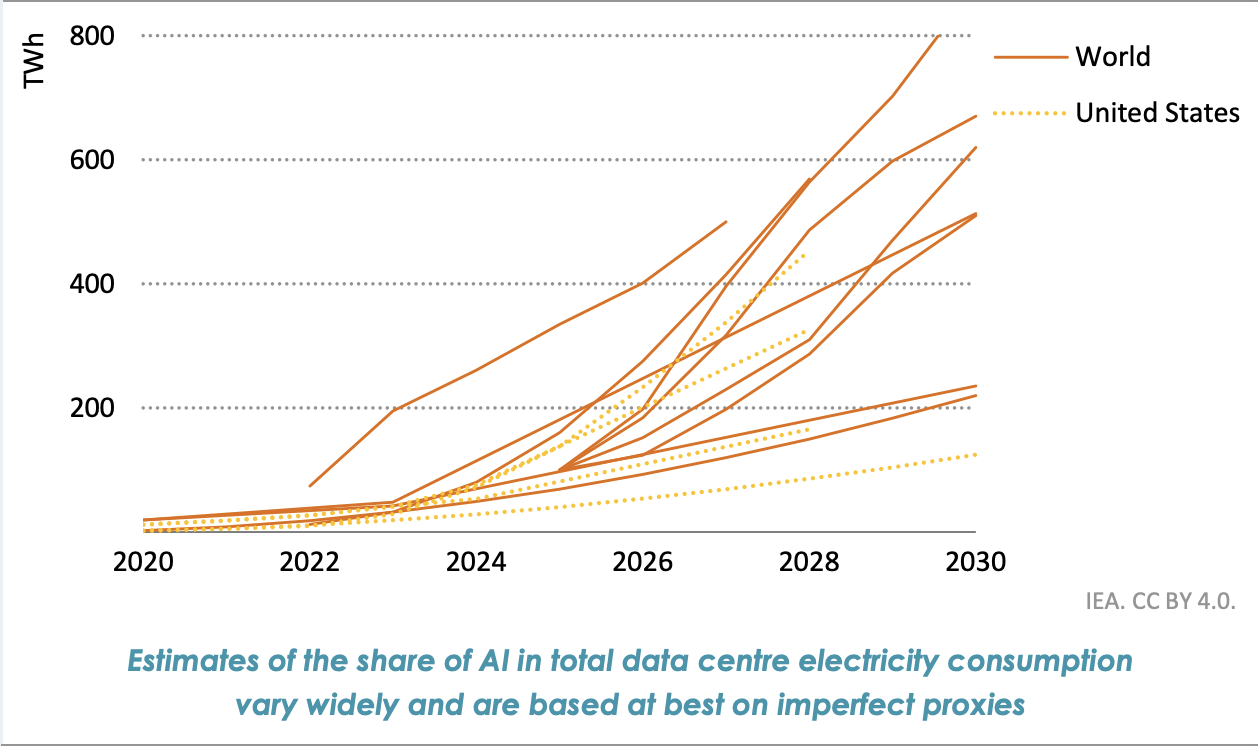
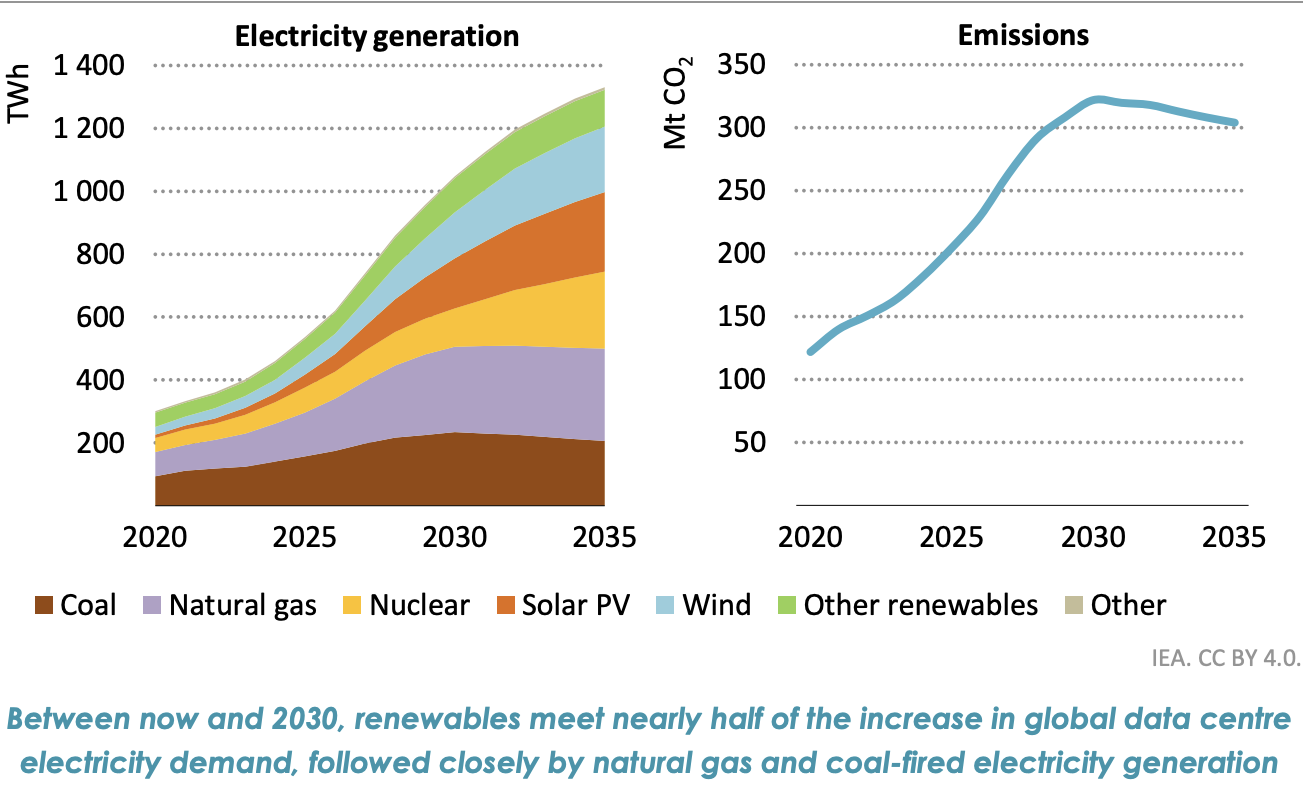
At the global level, the same acceleration is visible. In the International Energy Agency’s (IEA) 2025 Energy and AI report, it is projected that data center electricity consumption will rise from 415 terawatt-hours in 2024 to around 945 terawatt-hours by 2030.11 To better visualize 945 terawatt-hours in context, the consumption of the data center industry alone will be slightly more than the current entire annual electricity usage in Japan, a fully industrialized economy of about 122 million people.12 It is evident enough that the most important driver of that growth is the advancement of AI. Under this scope, the U.S. accounts for the largest share of total demand by 2030, and stands at 45% of global use as of 2024.13 They equivalently consume 450 to 470 terawatt-hours annually, which is more than six times the consumption level recorded fifteen years prior. When a data center operates, there are two distinct negative externalities: carbon emissions and water consumption at the grid level. Compiling operational data on 2,132 U.S. data centers in 2024, a peer-reviewed study discovered that approximately 56% of the electricity used to power those centers derived from fossil fuels, producing more than 105 million metric tons of carbon dioxide (CO₂) emissions, which is about 2.20 percent of total U.S. emissions in 2024.14 This aligns well with the IEA’s modeling of global electricity generation, where fossil fuel constitutes around 57% as of 2025.
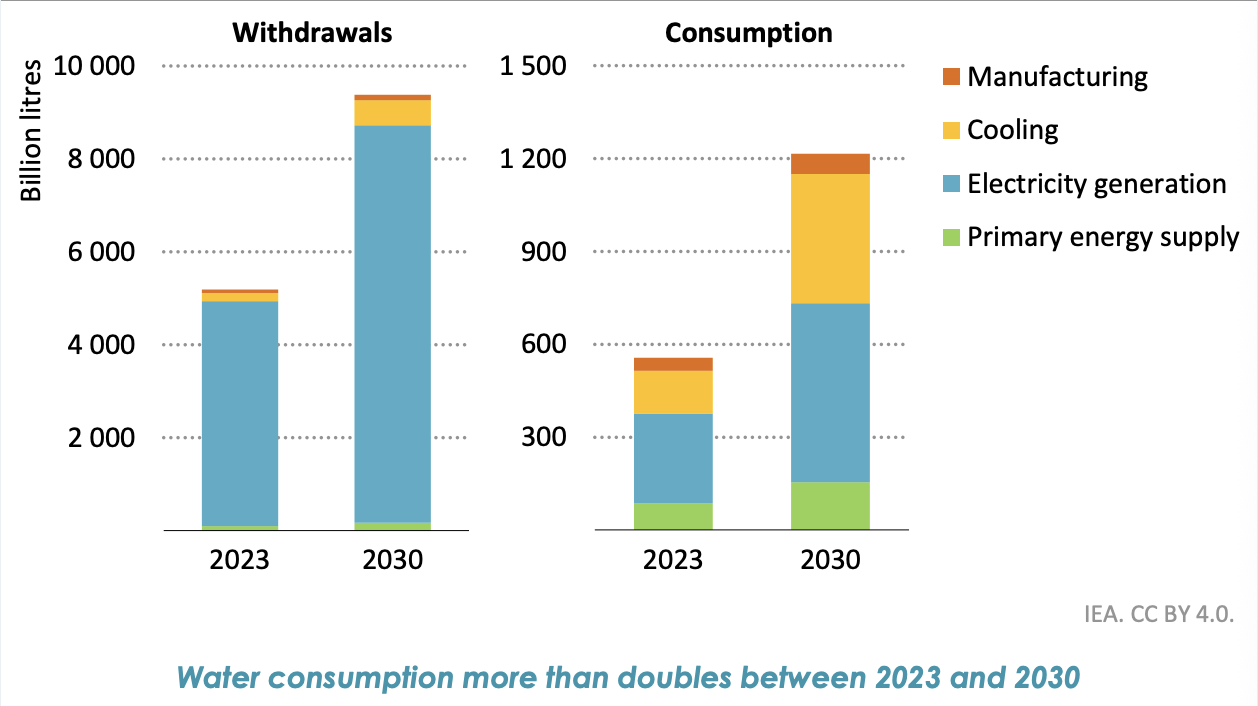
On the other hand, data centers depend on cooling systems at their core. Specifically, direct on-site evaporative cooling towers and indirect water usage by the fossil fuel power plants contribute to data center water consumption. In the U.S., 17.4 billion gallons of water were used through cooling in 2023 alone.15 It is forecasted that water usage for cooling will increase up to 870% in the coming years.16 On the global scale, water consumption for data centers uses 560 billion liters per year, rising up to an estimate of around 1.2 trillion liters per year in 2030. Water consumption has been split up by its usage: in 2023, two-thirds was relegated to primary energy supply and electricity generation, one-quarter to direct cooling, and the rest was used in semiconductor and microchip manufacturing.17 As corroborated in Figure 3, all aspects of water usage are expected to augment with the arrival of an AI-driven era.
It is also noted that neither carbon costs nor water costs are included in the current U.S. regulatory standards. The GHGRP explicitly excludes the indirect emissions from purchased grid electricity, which is the primary source of a data center’s carbon output because the facility itself does not combust fuel.18 The result is a classic negative externality outcome: the full social cost of data center expansion, under any obligation, is not reflected in the prices firms pay for electricity, water, or grid access but is instead distributed across electricity consumers, local water systems, and future generations. This generates the overproduction outcome standard economic theory predicts, where even rational and well-informed agents would bear the burden of expansion and marginal social costs that firms do not. The behavioral dimension becomes clear when actual and projected electricity demand is compared with the firms’ public climate commitments. For instance: Microsoft has pledged to be carbon negative by 2030; Google has committed to operating on 24/7 carbon-free energy by 2030; and Amazon has set a net-zero carbon target by 2040. Yet in a 2025 Nature Sustainability study, it was found that AI server deployment could generate between 24 and 44 million tons of CO₂ equivalent annually through 2030, and achieving net-zero requires a scale of carbon offset mechanisms that ceases to exist.19 This disparity is produced by optimism bias, as decision-makers are inclined to believe that their future plans will exceed the statistics that evidence-based modeling provides, skewed due to disclosure limitations as mentioned previously. Present and status quo biases are also manifested in the IEA’s statistical observations. The immediate rewards for investment expansion are salient for firms — market share and pioneering in the industry — but the environmental costs are diffused across the decades of operation, fogging the vision for a more sustainable world. Present bias is therefore apparent here, where tangible gains outweigh unpredictable future costs. Alongside this, status quo bias is seen through disclosure reports, where data center operators report environmental performance at the company level and not by dissecting AI workloads from other operations.20 This hinders investors’ ability to discern climate risks in AI infrastructure assets and prevents regulators from identifying precise intervention methods. It is then imperative for mandating policies to disaggregate metrics within the ‘environmental impacts’ indicator to clarify the long-term outlook.
IV. Policy Options Analysis
Re-establishing the AI data center energy crisis as the consequence of a layered failure, which includes negative externalities that standard pricing mechanisms have not corrected and the three behavioral distortions (present, optimism, and status quo bias), the ability to adopt corrective measures has not yet been developed at the necessary scale to undermine the complications that currently reside within the sector. Any policy response must therefore be evaluated not specifically on the externality in theory itself, but also by proving that it is capable of accounting for the obscure cognitive architecture in practice. The three policies identified to decipher the ambiguous area of behavioral economics in the AI data center energy sector operate adjacent to each other to counteract the three behavioral theories. Firstly, a carbon tax on data center electricity consumption. Carbon taxes primarily target the externality by pricing emissions, indirectly engaging with behavior.21 Secondly, a renewable energy procurement standard, where the default energy source will be revised away from fossil fuels, hence partially addressing status quo bias while also leaving present bias intact to allow for firms to continue their expansion of energy use in the short term. And lastly, a mandatory, standardized, disaggregated energy transparency disclosure regime that most confrontationally targets all three biases: it disrupts status quo bias by changing reporting defaults, counters optimism bias through verified public data, and leverages loss aversion by framing environmental underperformance as a pressing and subversive cost.
a. Option A: Carbon Tax on Data Center Electricity Consumption
With a carbon tax on grid-level carbon emissions associated with data center electricity consumption, operators are obliged to pay a federal fee per ton of CO₂ equivalent generated by the electricity they purchase. In the context of data centers, the tax would be levied at the utility level based on the carbon intensity of the grid serving each facility, with costs passed through to the data center operator in proportion to their electricity usage. Implementation would fall to the federal government, most plausibly through legislation by extending existing carbon pricing authority or a dedicated sectoral procedure administered jointly by the EPA and Department of Energy (DOE).
The carbon tax is the standard Pigouvian response to a negative externality that internalizes the social cost of carbon, attaching a price to emissions at the point of production.22 From a behavioral economics perspective, however, it only seeks to correct the externality and not the cognitive distortions that this paper recognizes to be the unspoken cause of the failure. In the Oxford Review of Economic Policy, Grubb et al. develop this critique by arguing that carbon pricing functions through a single decision-making domain centered particularly on rational price responses, stating that energy-intensive sectors involve at least two additional domains: habituated decision-making subject to bounded rationality and strategic investment with long lead times.23 According to their findings, neither domain is able to respond efficiently to price signals alone. Hence, a firm whose internal investment cycle is twelve to eighteen months will discount a carbon liability that accumulates over a fifteen to twenty-year facility lifespan exponentially, regardless of whether that liability is nominally priced.24 The tax would change what firms pay and not change what they psychologically perceive when deciding to expand.
Introduced in 1991, Sweden’s carbon tax, now levied at over $130 per ton (the highest rate in the world), provides a robust test of carbon pricing in a high-income economy.25 It was found in a quasi-experimental study that the tax reduced the Swedish transport sector’s CO₂ emissions by around 11 percent in comparison to a synthetic control of analogous Organization for Economic Co-operation and Development (OECD) countries, while its carbon tax elasticity of demand was three times larger than the standard price elasticity.26 This is a solid case to exemplify the usage of carbon taxes in reducing emissions at scale, proving it possible for its widespread operation in the data center sector.
Carbon taxes generate government revenue, which can be recycled into renewable grid investment; create a continuous and technology-neutral incentive; and be rather straightforward to extend to the electricity and data center sectors. As it is reinvested into renewable energy and grid infrastructure, the expansion of clean power supply will help to reduce the carbon intensity of electricity over time, assisting a smoother transition to a more sustainable future. Additionally, by attaching a cost to emissions regardless of how the methods are used, firms are encouraged to reduce carbon in whatever way they see most efficient. Because price signals are ongoing, it will assist in firms’ long-term investment plans to become more sustainable. Carbon taxes can be measured at the point of power generation or consumption, making these policies much simpler to implement in this specific sector.
A carbon tax is therefore economically necessary but behaviorally incomplete. It prices the externality, but it does not by itself redesign the choice environment that allows firms to discount long-term costs. Status quo bias persists because disclosure opacity remains; optimism bias persists because firms continue to believe their future efficiency gains will outpace the tax burden; and present bias persists because tax liability continues to be a future cost discounted against an immediate gain. Köppel and Schratzenstaller, in their empirical literature on carbon taxation, find that carbon taxes are most effective when firms believe they are permanent and unavoidable and short-term political uncertainty unravels as such.27 These limitations are not, however, intrinsic to the pricing mechanism itself since a carbon fee can engage loss aversion directly if its triggers are tied to disclosed and comparative performance.
b. Option B: Mandatory Renewable Energy Procurement Standard
A mandatory renewable energy procurement standard would require data center operators, specifically those above a defined capacity threshold, to obtain a minimum percentage of their electricity from renewable or carbon-free sources by a compliance date, rising incrementally toward 100 percent. Compliance will be managed through power purchase agreements (PPAs) with renewable generators, through renewable energy certificates (RECs), or even through on-site generation.28 Again, implementation will occur with governmental oversight through the DOE efficiency standards authority or through state-level public utility commission rulemaking, the latter of which has already been happening in several jurisdictions.29 By mandating data centers to procure renewable energy, this policy creates stable, long-term demand that guarantees revenue streams that lower financial risk and incentivize the expansion of new clean generation capacity.
This procurement standard addresses the supply side of the externality as it requires lower-carbon electricity sourcing without relying on the carbon price or adjusting firms’ internal future plans. Viewing it from a behavioral economics standpoint, it is more centralized as it changes the default, where operators must actively demonstrate renewable sourcing rather than just passively absorb the costs of the carbon tax.
As the most directly relevant precedent, in response to data centers in Ireland consuming a rapidly growing share of national electricity, projected to reach 32 percent by 2026 according to the IEA, Ireland imposed a requirement for operators to bring sufficient new power generation capacity online to meet their own demand, where new data center loads will be matched by new supply additions.30 BloombergNEF’s 2025 analysis of global data center decarbonization acknowledges Ireland’s efficient approach to counter data center development with renewable energy additions.31
As evidenced in Cole’s article, since it reforms the defaults, which are among the most well-documented mechanisms in nudge literature, they harness status quo bias rather than attempting to fight it.32 It is also more politically durable than a carbon tax, as it does not impose a direct financial burden on firms.
The fundamental weakness is that a procurement standard does not alter the informational environment in which expansion decisions are made. Though it will compel firms to source more renewable electricity, it does not make the full environmental impact of expanding data centers clearly visible to investors, clients, and regulators when deciding whether to expand. As a result, present bias will remain apparent. The early implementation of the EU’s regime also does not disclose AI-specific impacts, hence resulting in a transparency gap.33
c. Option C: Mandatory Disaggregated Energy Disclosure
A mandatory energy transparency disclosure regime, where data center operators are required to publish standardized, machine-readable energy and carbon intensity data on a recurring basis, will be separated by AI vs. non-AI workloads by facility locations and carbon intensity. Within the report, peer benchmarks are used to display each operator’s performance against the sector average and against the sector’s leading operators. Similar to the previous two, implementation would occur through the DOE and EPA, with the Securities and Exchange Commission (SEC) requiring disclosure from publicly traded operators. The EU’s Energy Efficiency Directive (EED) provides the structural template for this regime, and workload-level breakdown is what Lannelongue et al. identify as the critical addition needed to accurately assess AI’s environmental impact.34
This final option is most calibrated to address all three distortions simultaneously. Status quo bias is corrected due to the changes in existing reporting standards, making investment and procurement decisions much more visible than before.35 Next, present bias is apprehended through loss aversion: when disaggregated emissions data is public and standardized, underperforming operators are inclined to face reputational damage, investor repricing of climate risk, and client attrition, which are all registered as immediate, substantial losses. This is the precise mechanism that prospect theory leans on, since Kahneman and Tversky emphasize the doubling effect that losses portray when compared to gains. Optimism bias is ultimately tackled through the firms’ independent accountability, where operators have to acutely plan their assumptions so as to not exaggerate their outlooks when compared to the visible data that can be proven publicly falsifiable. Lannelongue et al. push for such implementation, concluding that the estimation accuracy of AI’s impact on the environment would drastically improve if firms disclosed specific locations and magnitudes of AI workload operations.36
The EU’s EED provides a legislative model where any EU data center operators that run above 500 kilowatts are needed to report energy consumption, power usage effectiveness, water consumption, and renewable energy sourcing to a centralized European database annually.37 The Commission has signaled minimum performance standards that will follow in 2026, contingent on data being collected as the foundation. This mirrors the nudge logic where transparency comes first, allowing behavior to adjust as stricter mandates are imposed.38 A parallel is manifested in Opower’s energy reports on a household level, finding that across nearly 600,000 treatments and control households, electricity consumption decreased by 2 percent when disclosure and comparisons were made available without any price signal.39
The regime ensures operator freedom while it helps to improve the information environment in which decisions are made. It also successfully enforces lower political and financial costs than a carbon tax, while it builds on a model already operating at scale.40 Most importantly, it addresses the core failure the theory identifies: the lack of clear and accessible information about environmental impact.
Disclosure alone does not cap emissions, since its effectiveness depends on whether stakeholders act on the information provided. Paunov et al. also find that nudge-based interventions can decay as time progresses and the novelty of disclosure fades.41 Nevertheless, this risk is already mitigated by its design, as workload-level separation ensures data remains productive while peer benchmarking sustains competition in an increasingly ambitious world.
V. Policy Recommendation & Justification
Despite the ongoing decade-long efforts to implement climate policies, the U.S. has imposed no binding sector-specific mechanism on the largest accelerator of new electricity demand: AI data centers. The disconnect between corporate sustainability commitments and the likely real-world emissions outcome of AI infrastructure is the behavioral market failure the paper identifies, illustrating why the measures that this section develops are necessary to address the underlying behavioral drivers of energy expansion in the AI data center sector. Through a three-pillar Energy Accountability Plan, it will be mandated for U.S. data center operators, above one megawatt of installed IT power capacity, to utilize the strongest elements from each option analyzed in Section IV into a single sequenced regimen.
Pillar One: Mandatory Disaggregated Transparency Disclosure
Extracted from Option C, Pillar One would require quarterly disaggregated public disclosure of energy and carbon intensity data, separated by AI versus non-AI workload, by facility, and by grid carbon intensity, with each report including a peer benchmark against the sector median and the best-in-class operators in the same grid region. This would be the largest component of the accountability plan.
Pillar Two: Graduated Carbon Adjustment Fee
Taken from Option A, Pillar Two would impose a modest graduated carbon adjustment fee on operators whose disclosed performance declines below the sector median. The fee should be calibrated modestly to avoid the initial political opposition but high enough to engender immediate financial incentives for emissions reduction, efficiency improvements, and climate prudence.
Pillar Three: Conditional Renewable Procurement Requirement
Adapted from Option B, Pillar Three would entail operators falling below the benchmark for two consecutive quarters to submit a binding renewable-sourcing transition plan within twelve months, enforced through DOE oversight. This requirement is a corrective mechanism that tackles persistent underperformance while preserving flexibility for those who adhere well to sustainability.
Implementation will take effect through the collaboration of the DOE, EPA, and SEC under existing authority. Although the three-pillar policy framework aims to apply to data center operators, its effect is also to improve the decisions made by investors, clients, regulators, etc. who lack the sufficient and unambiguous information to evaluate the environmental consequences of AI infrastructure expansion. Each pillar seeks to address a distinct behavioral mechanism the case study identifies, and the combination is intended to produce effects that they cannot achieve independently. Here, the framework is justified on three planes that it pursues to expand from Section IV: specific implementations, equity, and cost-benefit analysis. The 1-megawatt threshold is adjusted to seize the majority of the operators responsible for consumption while allowing leeway for smaller facilities. The 2024 Lawrence Berkeley National Laboratory estimates that hyperscale and large facilities account for over 70 percent of U.S. data center electricity consumption, though they only represent a small fraction of facility counts.42 The threshold-based regime, therefore, tackles this issue while also imposing compliance costs on a small, well-resourced subset of firms. It is also structured to be more progressive, where compliance costs scale with operator size, falling heavily on larger operators that account for the largest share of both consumption and corporate market capitalization. Stated in the Congressional Research Service, these large firms account for 43 percent of clean PPAs signed in 2024, indicating they have both the resources and incentives to absorb these compliances without being placed at a competitively disadvantaged height.43 From a cost-benefit perspective, the graduated fee component generates federal revenue explicitly directed to renewable grid investment, a renewable-recycling design that a meta-analysis of eighty causal ex post evaluations across twenty-one carbon pricing schemes found to correlate with larger emissions reductions and greater political durability.44 The comparative advantage is made architectural: each policy tool triggers and strengthens the others. Across the three pillars, transparency creates accountability (status quo bias and optimism bias); accountability creates financial and social pressure (present bias and loss aversion); and persistent underperformance triggers stricter requirements. This is the policy complementarity that Grubb et al. argue is necessary in sectors dominated by bounded rationality.45 The strongest objection to the framework is administrative complexity, where the combination of the pillars may create compliance costs disproportionate to the full benefit. Operators will challenge the fee component as an overreach beyond disclosure, which will stir tensions. However, this objection is weakened by real-world evidence: the EU’s EED has demonstrated since 2024 that mandatory data center disclosure is administratively feasible at the scale of a major industrialized economy, and the proposed graduated fee is calculated to be low enough to prevent an uproar.46 A second objection comes from the behavioral effect of the interventions losing effectiveness over time as organizations become accustomed to them. The framework, however, addresses this risk ideally by combining the three mechanisms to reinforce one another rather than relying solely on disclosure.47 A third objection may arise from the firms’ choice of relocating their infrastructure to a less-regulated jurisdiction. This is ultimately countered by the U.S.’s position as the largest national market as well as the EU’s parallel regulatory regime, which together cover the majority of global hyperscale operators.
Table 1. Policy options compared by behavioral mechanism.
| Policy Option | Present Bias | Optimism Bias | Status Quo Bias | Externality Pricing | Main Weakness |
|---|---|---|---|---|---|
| Carbon tax | Partial | Weaker | Weaker | Stronger | Future costs may still be discounted |
| Renewable procurement standard | Partial | Moderate | Stronger | Moderate | Does not reveal AI-specific use |
| Disaggregated disclosure | Stronger | Stronger | Stronger | Weak alone | Depends on stakeholder response |
| Three-pillar plan | Stronger | Stronger | Stronger | Stronger | Administrative complexity |
Successful implementation of this pillar framework, then, would lay the baseline for three precedents: (1) it would prove that integrated behavioral and pricing regimes are politically viable in the U.S., where standalone carbon taxes have repeatedly failed; (2) the workload-level disaggregation principle would create a replicable template that would influence other sectors, such as manufacturing, transportation, etc.; and (3) most importantly, the framework would provide the basis for effective climate policy addressing not only economic incentives but also the informational environment in which decisions are made. More broadly, successful implementation would redefine the role of the U.S. in the AI industry, transforming its position as the source of 45 percent of global data center electricity demand into a model of transparency and accountable governance.
Traditional economics prescribes the need to price externalities, which is necessary. But behavioral economics displays that price signals alone are not sufficient when biases distort firms’ perceptions of long-term costs. This framework used to address the data center case is not a ceiling of policy implementation but a proof of concept applicable to other aspects of the world.
VI. Conclusion
The argument this paper has established stems from an observation that standard environmental economics, which assumes firms will respond rationally to pricing and informational signals, cannot fully explain. It is not that U.S. technology firms intending to expand AI infrastructure do not possess astute scientists, do not do due diligence in their published sustainability reports, or are not even genuinely passionate about the sustainable future; it is the current electricity consumption trends that suggest these commitments are unlikely to be achievable within the decade. A reason that treats this disconnect as merely and simply an informational problem cannot explain why the gap between corporate climate commitments and actual emissions trajectories has continued to widen despite the steady accumulation of climate data. Additionally, it cannot be an externality issue since the available pricing mechanisms have failed to perform over time. The paper has, in a nutshell, an assemblage of data to assert the cognitive structure of institutional decision-making as the explanatory burden. The three biases the case study pinpoints — the disproportionate weight assigned to immediate competitive returns over long-term costs, the overestimation of future plans relative to evidence-based modeling, and the reliance on aggregated-rather-than-disaggregated disclosure standards — are all just a feature that prevents existing corrective mechanisms from taking effect. They are embedded conditions within the decision-making environment itself, preventing single-policy responses to adequately address the problem. The three-pillar Accountability Plan is an attempt to design a policy that corresponds to what single-policy responses could not do by themselves. Disaggregated disclosure helps to replace the ambiguous reporting default that sustains status quo bias and makes optimism-biased projections falsifiable against measured data. A graduated fee tied to disclosed underperformance converts the distant environmental cost of expansion into visible, direct, and recurring consequences; this is exactly the loss of what prospect theory determines to be the strongest available counterweight to present bias. And a conditional renewable procurement requirement imposes a constraint when and if the first two fail to address operator behavior. In totality, the three pillars act as a sequence, where disclosure leads to transparency, transparency leads to accountability, and persistent underperformance leads to tighter corrective action. The paper does not dispute the neoclassical externality framework. It argues that behavioral economics extends and completes that framework when applied to environmental policy. Since standard environmental economics assumes that once environmental costs are priced, rational firms will respond accordingly to reduce harm to the environment. But this does not constitute the AI data center sector. The framework proposed here views pricing mechanisms as underperforming when institutional decision-making is molded by bounded rationality. An effective climate policy is therefore not just pricing the externalities but also redesigning the informational and behavioral environment in which those price signals operate. Though AI data centers are a clear epitome of the situation, the logic extends to other sectors where short-term competitive pressures overwhelm long-term environmental considerations. It is in these domains that climate policies can succeed where structuring decision-making biases begin to account for predictable, behavioral biases.
Bibliography
Allcott, Hunt. "Social Norms and Energy Conservation." Journal of Public Economics 95, nos. 9-10 (2011): 1082-95. https://doi.org/10.1016/j.jpubeco.2011.03.003.
Andersson, Julius J. "Carbon Taxes and CO2 Emissions: Sweden as a Case Study." American Economic Journal: Economic Policy 11, no. 4 (2019): 1-30. https://doi.org/10.1257/pol.20170144.
Cole, David. "Our Nudge in Chief." The Atlantic. Last modified May 2014. Accessed April 7, 2026. https://www.theatlantic.com/magazine/archive/2014/05/our-nudge-in-chief/359804/.
Cramton, Peter, Axel Ockenfels, and Steven Stoft. "Capacity Market Fundamentals." Economics of Energy and Environmental Policy 2, no. 2 (2013). https://doi.org/10.5547/2160-5890.2.2.2.
de Vries-Gao, Alex. "The Carbon and Water Footprints of Data Centers and What This Could Mean for Artificial Intelligence." Patterns 7, no. 1 (2026): 101430. https://doi.org/10.1016/j.patter.2025.101430.
Döbbeling-Hildebrandt, Niklas, Klaas Miersch, Tarun M. Khanna, et al. "Systematic Review and Meta-analysis of Ex-post Evaluations on the Effectiveness of Carbon Pricing." Nature Communications 15, no. 1 (2024). https://doi.org/10.1038/s41467-024-48512-w.
International Energy Agency, Energy and AI. April 10, 2025. Accessed April 7, 2026. https://www.iea.org/reports/energy-and-ai.
"Energy Performance of Data Centres." Europa. https://energy.ec.europa.eu/topics/energy-efficiency/energy-efficiency-targets-directive-and-rules/energy-efficiency-directive/energy-performance-data-centres_en.
Greenhouse Gas Reporting Program (GHGRP). Accessed April 23, 2026. https://www.epa.gov/ghgreporting/what-ghgrp.
Grubb, Michael, Alexandra Poncia, Paul Drummond, Karsten Neuhoff, and Jean-Charles Hourcade. "Policy Complementarity and the Paradox of Carbon Pricing." Oxford Review of Economic Policy 39, no. 4 (2023): 711-30. https://doi.org/10.1093/oxrep/grad045.
Guide to Purchasing Green Power, H.R. Rep. (Mar. 10, 2010). https://www.epa.gov/greenpower/guide-purchasing-green-power.
Guidi, Gianluca, Francesca Dominici, Jonathan Gilmour, et al. Environmental Burden of United States Data Centers in the Artificial Intelligence Era. November 14, 2024. Accessed April 23, 2026. https://doi.org/10.48550/ARXIV.2411.09786.
Hegde, Ganesh. "Myths Vs. Reality: Data Centers and Water Usage." Florida Water and Pollution Control Operators Association, January 23, 2026. Accessed April 23, 2026. https://www.fwpcoa.org/content.aspx?page_id=5&club_id=859275&item_id=130961.
James, Kirsten, Shama Perveen, Benjamin Jacobson, Tianyi Luo, and Paul Reig. Drained by Data: The Cumulative Impact of Data Centers on Regional Water Stress. September 23, 2025. Accessed April 23, 2026. https://www.ceres.org/resources/reports/drained-by-data-the-cumulative-impact-of-data-centers-on-regional-water-stress.
Jonsson, Samuel, Anders Ydstedt, and Elke Asen. "Looking Back on 30 Years of Carbon Taxes in Sweden." Tax Foundation Europe, September 23, 2020. https://taxfoundation.org/research/all/eu/sweden-carbon-tax-revenue-greenhouse-gas-emissions/.
Kahneman, Daniel, and Amos Tversky. "Prospect Theory: An Analysis of Decision under Risk." Econometrica 47, no. 2 (1979): 263-91. https://doi.org/10.2307/1914185.
Köppl, Angela, and Margit Schratzenstaller. "Carbon Taxation: A Review of the Empirical Literature." Journal of Economic Surveys 37, no. 4 (2022): 1353-88. https://doi.org/10.1111/joes.12531.
Korteling, Johan E., Geerte L. Paradies, and Josephine P. Sassen-van Meer. "Cognitive Bias and How to Improve Sustainable Decision Making." Frontiers in Psychology 14 (February 2023). https://doi.org/10.3389/fpsyg.2023.1129835.
Lyu, Jinghong, and Sisi Tang. "Power Hungry Data Centers Are Driving Green Energy Demand." BloombergNEF, o.s., August 26, 2025. https://about.bnef.com/insights/clean-energy/power-hungry-data-centers-are-driving-green-energy-demand/.
Moeller, David. "Power, Policy, and Scale: Inside the State Regulatory Response to Data Center Expansion." Power, May 1, 2026. https://www.powermag.com/power-policy-and-scale-inside-the-state-regulatory-response-to-data-center-expansion/.
Paunov, Yavor, and Till Grüne-Yanoff. "Boosting Vs. Nudging Sustainable Energy Consumption: A Long-term Comparative Field Test in a Residential Context." Behavioural Public Policy 10, no. 1 (2023): 42-67. https://doi.org/10.1017/bpp.2023.30.
Pigou, Arthur Cecil. The Economics of Welfare. Accessed May 2, 2026. https://oll.libertyfund.org/titles/pigou-the-economics-of-welfare.
Pomerleau, Kyle, and Elke Asen. Carbon Tax and Revenue Recycling: Revenue, Economic, and Distributional Implications. https://taxfoundation.org/research/all/federal/carbon-tax/.
Shehabi, Arman, Alex Newkirk, Sarah J. Smith, et al. 2024 United States Data Center Energy Usage Report. December 2024. Accessed April 22, 2026. https://doi.org/10.71468/P1WC7Q.
Xiao, Tianqi, Francesco Fuso Nerini, H. Damon Matthews, Massimo Tavoni, and Fengqi You. "Environmental Impact and Net-zero Pathways for Sustainable Artificial Intelligence Servers in the USA." Nature Sustainability 8, no. 12 (2025): 1541-53. https://doi.org/10.1038/s41893-025-01681-y.
Appendix: Abbreviations
| Abbreviation | Full Term |
|---|---|
| DOE | Department of Energy |
| EED | Energy Efficiency Directive |
| EPA | Environmental Protection Agency |
| GHGRP | Greenhouse Gas Reporting Program |
| IEA | International Energy Agency |
| OECD | Organization for Economic Co-operation and Development |
| PPAs | Power Purchase Agreements |
| RECs | Renewable Energy Certificates |
| SEC | Securities and Exchange Commission |
| SWOT | Strengths-Weakesses-Opportunities-Threats |
-
International Energy Agency, Energy and AI, 23, April 10, 2025, accessed April 7, 2026, https://www.iea.org/reports/energy-and-ai. ↩
-
Tianqi Xiao et al., “Environmental Impact and Net-zero Pathways for Sustainable Artificial Intelligence Servers in the USA,” Nature Sustainability 8, no. 12 (2025): 1541, https://doi.org/10.1038/s41893-025-01681-y. ↩
-
Greenhouse Gas Reporting Program (GHGRP), accessed April 23, 2026, https://www.epa.gov/ghgreporting/what-ghgrp. ↩
-
“Energy Performance of Data Centres,” Europa, https://energy.ec.europa.eu/topics/energy-efficiency/energy-efficiency-targets-directive-and-rules/energy-efficiency-directive/energy-performance-data-centres_en. ↩
-
Daniel Kahneman and Amos Tversky, “Prospect Theory: An Analysis of Decision under Risk,” Econometrica 47, no. 2 (1979): 264, https://doi.org/10.2307/1914185. ↩
-
David Cole, “Our Nudge in Chief,” The Atlantic, last modified May 2014, accessed April 7, 2026, https://www.theatlantic.com/magazine/archive/2014/05/our-nudge-in-chief/359804/ ↩
-
Cole, “Our Nudge,” The Atlantic. ↩
-
Arman Shehabi et al., 2024 United States Data Center Energy Usage Report, 5, December 2024, accessed April 22, 2026, https://doi.org/10.71468/P1WC7Q. ↩
-
Shehabi et al., 2024 United, 6. ↩
-
Shehabi et al., 2024 United, 49. ↩
-
International Energy Agency, Energy and AI, 63. ↩
-
International Energy Agency, Energy and AI, 14. ↩
-
International Energy Agency, Energy and AI, 14. ↩
-
Gianluca Guidi et al., Environmental Burden of United States Data Centers in the Artificial Intelligence Era, 7, November 14, 2024, accessed April 23, 2026, https://doi.org/10.48550/ARXIV.2411.09786. ↩
-
Ganesh Hegde, “Myths Vs. Reality: Data Centers and Water Usage,” Florida Water and Pollution Control Operators Association, January 23, 2026, accessed April 23, 2026, https://www.fwpcoa.org/content.aspx?page_id=5&club_id=859275&item_id=130961. ↩
-
Kirsten James et al., Drained by Data: The Cumulative Impact of Data Centers on Regional Water Stress, 8, September 23, 2025, accessed April 23, 2026, https://www.ceres.org/resources/reports/drained-by-data-the-cumulative-impact-of-data-centers-on-regional-water-stress. ↩
-
International Energy Agency, Energy and AI, 242. ↩
-
Greenhouse Gas Reporting Program (GHGRP), accessed April 23, 2026, https://www.epa.gov/ghgreporting/what-ghgrp. ↩
-
Xiao et al., “Environmental Impact,” 1541. ↩
-
Alex de Vries-Gao, “The Carbon and Water Footprints of Data Centers and What This Could Mean for Artificial Intelligence,” Patterns 7, no. 1 (2026): 4, https://doi.org/10.1016/j.patter.2025.101430. ↩
-
Michael Grubb et al., “Policy Complementarity and the Paradox of Carbon Pricing,” Oxford Review of Economic Policy 39, no. 4 (2023): 720, https://doi.org/10.1093/oxrep/grad045. ↩
-
Kyle Pomerleau and Elke Asen, Carbon Tax and Revenue Recycling: Revenue, Economic, and Distributional Implications, 3, https://taxfoundation.org/research/all/federal/carbon-tax/. ↩
-
Grubb et al., “Policy Complementarity,” 715. ↩
-
Kahneman and Tversky, “Prospect Theory,” 286. ↩
-
Samuel Jonsson et al., “Looking Back on 30 Years of Carbon Taxes in Sweden,” Tax Foundation Europe, September 23, 2020, 11, https://taxfoundation.org/research/all/eu/sweden-carbon-tax-revenue-greenhouse-gas-emissions/. ↩
-
Julius J. Andersson, “Carbon Taxes and CO2 Emissions: Sweden as a Case Study,” American Economic Journal: Economic Policy 11, no. 4 (2019): 3, https://doi.org/10.1257/pol.20170144. ↩
-
Angela Köppl and Margit Schratzenstaller, “Carbon Taxation: A Review of the Empirical Literature,” Journal of Economic Surveys 37, no. 4 (2022): 1358, https://doi.org/10.1111/joes.12531. ↩
-
Guide to Purchasing Green Power, H.R. Rep. (Mar. 10, 2010). https://www.epa.gov/greenpower/guide-purchasing-green-power. ↩
-
David Moeller, “Power, Policy, and Scale: Inside the State Regulatory Response to Data Center Expansion,” Power, May 1, 2026, https://www.powermag.com/power-policy-and-scale-inside-the-state-regulatory-response-to-data-center-expansion/. ↩
-
Jinghong Lyu and Sisi Tang, “Power Hungry Data Centers Are Driving Green Energy Demand,” BloombergNEF, o.s., August 26, 2025, https://about.bnef.com/insights/clean-energy/power-hungry-data-centers-are-driving-green-energy-demand/. ↩
-
Lyu and Tang, “Power Hungry.” ↩
-
Cole, “Our Nudge,” The Atlantic. ↩
-
Alex de Vries-Gao, “The Carbon and Water Footprints of Data Centers and What This Could Mean for Artificial Intelligence,” Patterns 7, no. 1 (2026): https://doi.org/10.1016/j.patter.2025.101430. ↩
-
de Vries-Gao, “The Carbon.” ↩
-
Cole, “Our Nudge,” The Atlantic. ↩
-
de Vries-Gao, “The Carbon.” ↩
-
“Energy Performance.” ↩
-
Cole, “Our Nudge,” The Atlantic. ↩
-
Hunt Allcott, “Social Norms and Energy Conservation,” Journal of Public Economics 95, nos. 9-10 (2011): https://doi.org/10.1016/j.jpubeco.2011.03.003. ↩
-
“Energy Performance.” ↩
-
Yavor Paunov and Till Grüne-Yanoff, “Boosting Vs. Nudging Sustainable Energy Consumption: A Long-term Comparative Field Test in a Residential Context,” Behavioural Public Policy 10, no. 1 (2023): 44, 62, https://doi.org/10.1017/bpp.2023.30. ↩
-
Shehabi et al., 2024 United, 20. ↩
-
Lyu and Tang, “Power Hungry.” ↩
-
Niklas Döbbeling-Hildebrandt et al., “Systematic Review and Meta-analysis of Ex-post Evaluations on the Effectiveness of Carbon Pricing,” Nature Communications 15, no. 1 (2024): 2, https://doi.org/10.1038/s41467-024-48512-w. ↩
-
Grubb et al., “Policy Complementarity,” 712. ↩
-
“Energy Performance.” ↩
-
Paunov and Grüne-Yanoff, “Boosting Vs. Nudging,” 44. ↩