Refraction of Reality
Draws on Robert Rosenblum’s essay “Cubism” to argue that Cubism reveals perception as an act of interpretation, contrasting Cézanne with Picasso’s Les Demoiselles d’Avignon.
Works discussed
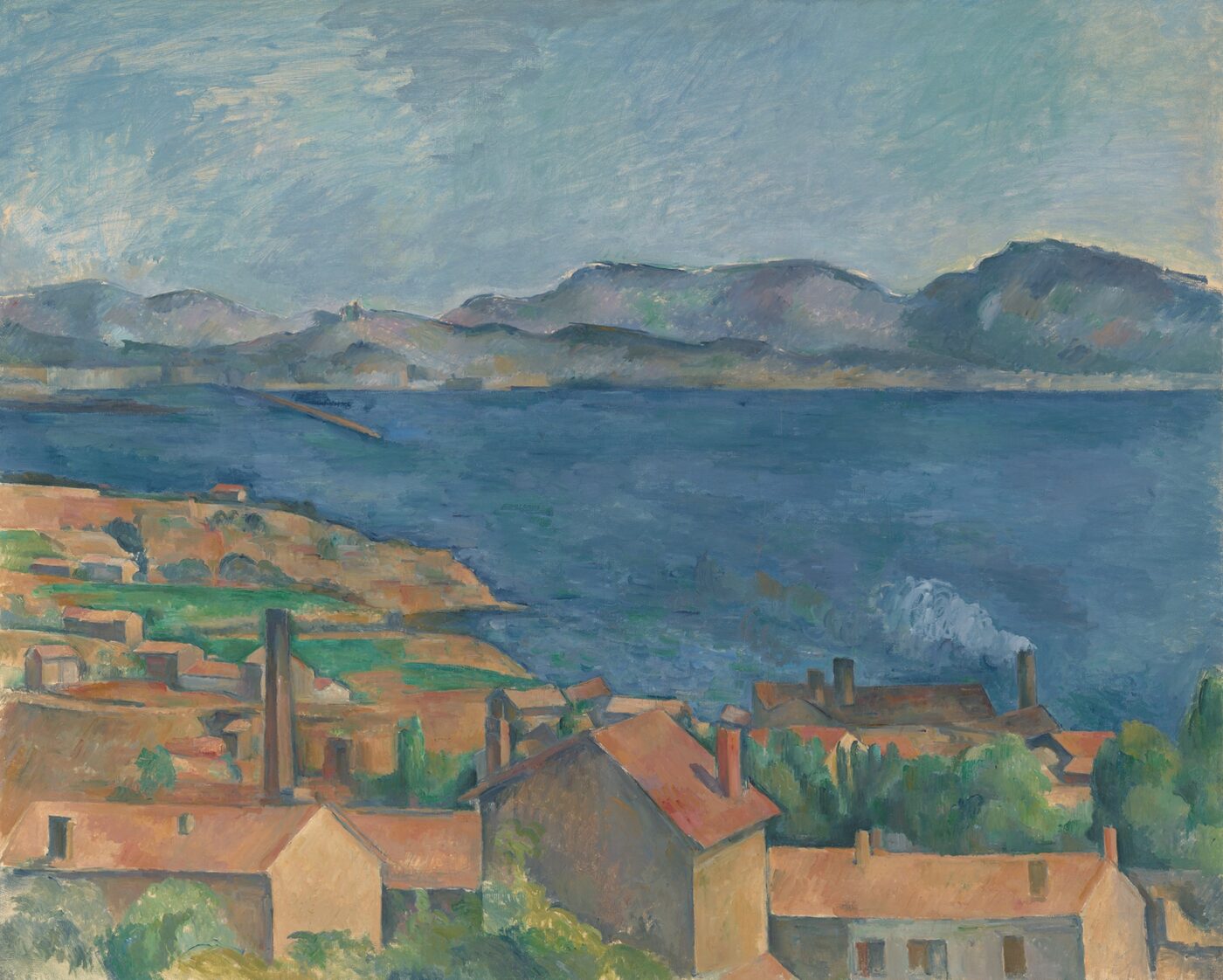
- Paul Cézanne, The Bay of Marseilles, Seen from L’Estaque, 1885
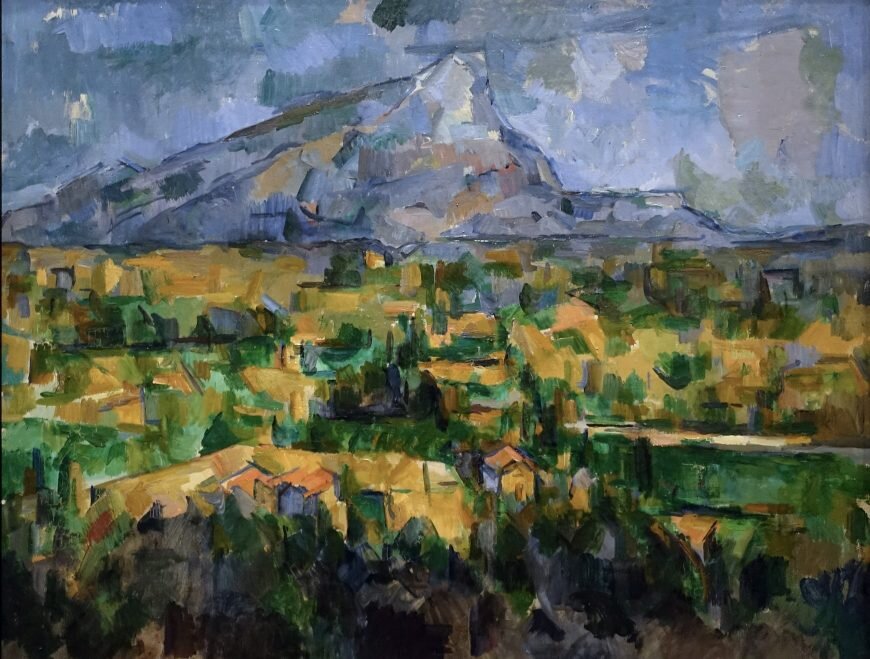
- Paul Cézanne, Mont Sainte-Victoire Seen from Les Lauves, 1905
- Pablo Picasso, Les Demoiselles d’Avignon, 1907, The Museum of Modern Art, New York (view at MoMA)
For centuries, Western painters operated on the philosophy that the canvas was a transparent window where the viewer observed reality. In his essay, “Cubism,” Rosenblum dismantles this premise entirely. In his telling, Cubism neither destroys nor reconstructs reality. Instead, it reveals that perception was always an act of interpretation (Rosenblum 396). What Cubism does is the process by which the mind transforms the viewed world into a representation.
Rosenblum is careful to distinguish this ‘representation’ from pure abstraction. He insists that Cubist works maintain “an ultimate reference to external reality” and that without this attachment, Cubism’s fundamental tension between the demands of nature and art would not exist (Rosenblum 407). A still life will remain a still life; a musician will remain a musician. Yet the object of a Cubist piece will no longer be rendered as a single, distinct viewpoint in a stable light. Rosenblum sees it fractured into what he calls “an unstable structure of dismembered planes in indeterminate spatial positions” (Rosenblum 395). These are planes that shift, contradict, and overlap with one another to present what the eye could never catch. The Cubist canvas exposes the conditions under which we perceive it and never truly abolishes the world.
It is here that Cubism constitutes a decisive rupture from even the most progressive work of the preceding generation. Cézanne, whom Rosenblum positions as its key antecedent, sustained a “dual homage to optically perceived nature and intellectually conceived art.” This duality is evident in The Bay of Marseilles, Seen from L’Estaque and Mont Sainte-Victoire Seen from Les Lauves, where Cézanne preserves structural order beneath the surface of the canvas, rendering the landscape as a network of interlocking geometric passages (Rosenblum 401). However, light continues to fall coherently, and volume remains unified in visible and clear amounts. Though Cézanne fragments forms and destabilizes strict naturalism, he does not destroy the viewer’s ability to recognize and collect what they see. They are, through perception, still able to make out what is illustrated.
But Picasso’s Les Demoiselles d’Avignon heavily refutes the compromise described above. Rosenblum treats it radically differently from any other works of the time, including Munch’s The Scream and Van Gogh’s Starry Night. While the former distorts form through psychological intensity and the latter charges the visible world with an almost supernatural energy, both are - similar to Cézanne - still able to retain a legible perspective. In Les Demoiselles d’Avignon, that entire stance collapses. The figures are distorted into jagged, mask-like forms, with multiple viewpoints coexisting simultaneously. Perspective no longer organizes the image and the viewer is unable to synthesize the scene. Rather than depicting how the world appears, the painting shoves instability into the viewer’s perception, allowing subjectivity of interpretation to seize control (Rosenblum 402).
Cubism portrays not a new reality or a multidimensional plane of existence, but the constructive nature of seeing. It transforms representation from a passive, quiet reflection of the world into an active process of interpretation. Simply enough, it dismantles the illusion that reality can be directly and accessibly simulated without overindulging in abstraction.
Works Cited
Cézanne, Paul. The Bay of Marseilles, Seen from L'Estaque. 1885.
---. Mont Sainte-Victoire Seen from Les Lauves. 1905.
Picasso, Pablo. Les Demoiselles d'Avignon. 1907.
Rosenblum, Robert. Cubism. Accessed 15 Apr. 2026.