Suspended Out of Time
Connects Muybridge’s sequential photography with the Great Exhibition of 1851, arguing that both froze experience into still, commodified instants.
Works discussed
- Eadweard Muybridge, The Horse in Motion, 1878
- The Crystal Palace, Great Exhibition, London, 1851
The great Victorian exhibitions were a spectacle that celebrated industrial commerce on an international stage, an unprecedented approach that laid the foundation for modernized shopping malls (Exhibition in Paris). On the other hand, a solitary scientist who decomposed motion in a California studio, Eadweard Muybridge, used sequential photography to break down motion into segments: a galloping horse suspended across a strip of frames, each captured in a fraction of a second that not even the eye alone can capture (Frampton 24). Through both innovations, a parallel emerges: both are products of the same nineteenth-century impulse to make the invisible visible and, in doing so, to transform “experience” into something commodifiable.
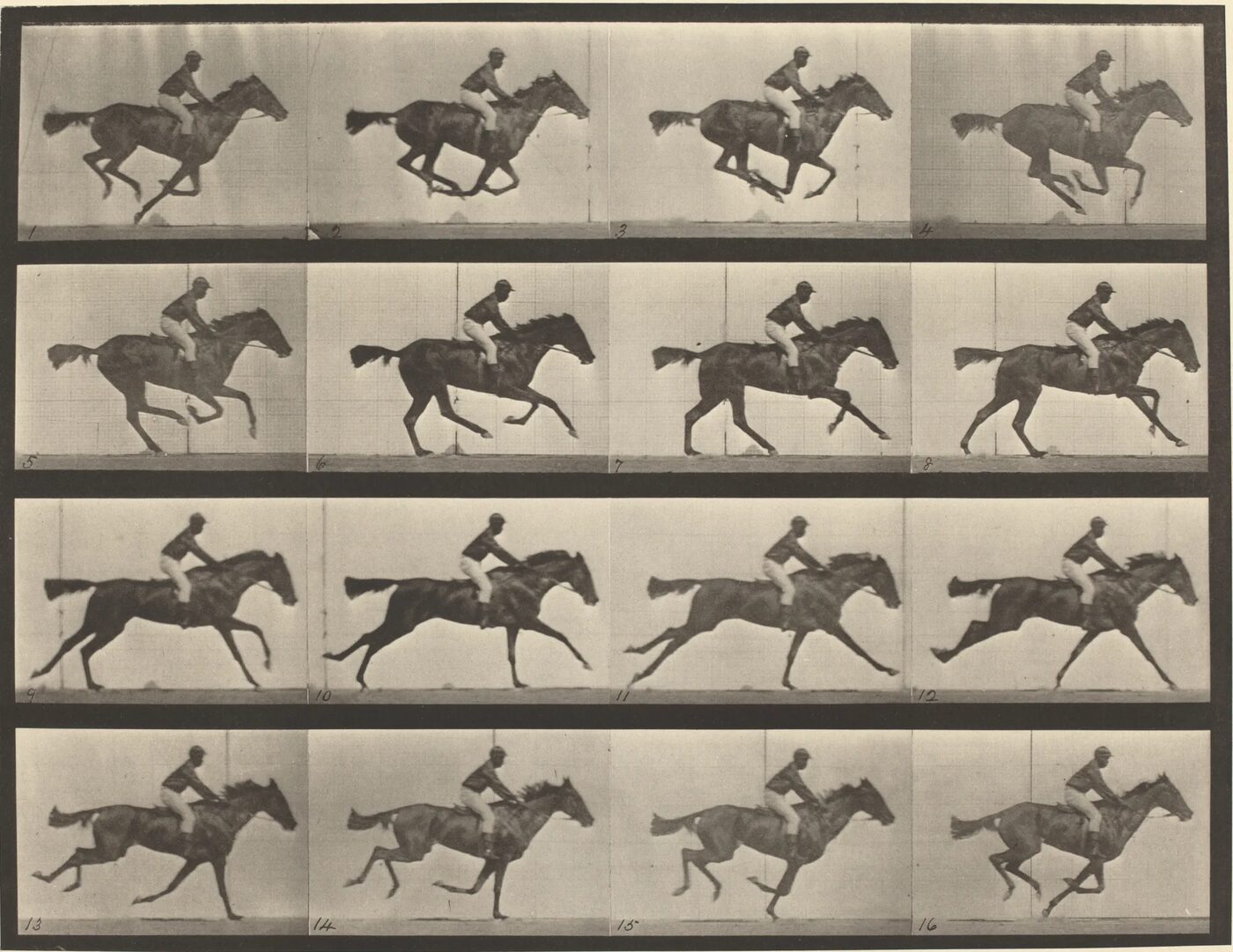
Muybridge’s philosophical contribution, framed through Frampton’s concept of the tesseract, is the idea that time is not continuous but rather a succession of discrete, static instants (Frampton 26). This is evident in “The Horse in Motion,” a series of frozen frames assimilated together, not one fluid movement. Inferring from this obsession with decomposition arrives the logic of the Crystal Palace exhibition. Over fourteen thousand objects were placed on eighteen acres of glass and iron, and each was extracted from its context of production and use, held up for inspection, and assigned an exchange value in competition with every other object (Exhibition in Paris). The exhibition, like Muybridge’s strip of frames, suspended things out of time.
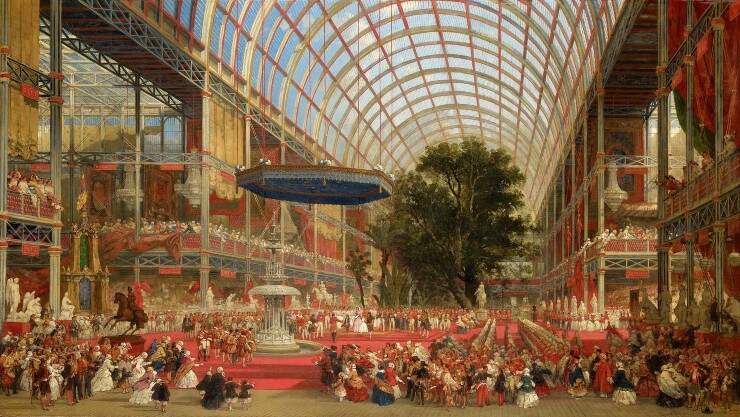
This is where Marx’s concept of the “Fetishization of Commodities” comes into play. Under capitalism, an object loses its identity as a product of human labor, acquiring a sign-exchange value - a meaning not determined by its functionality, but more so by the simple act of possessing it (Exhibition in Paris). The Crystal Palace was the machine, just like through Muybridge’s lens, that enacted this transformation at a civilizational scale. People from across England came not to use the goods; they came to see them, to become spectators and “want-ers.” Walter Benjamin, too, recognized this: the arcades of Paris were phantasmagorias, dream worlds designed to seduce rather than to satisfy (Benjamin 152).
Muybridge’s zoopraxiscope, which resynthesized his still frames into the illusion of motion, offers an uncanny metaphor for this process (Frampton 23). Capitalism, like the zoopraxiscope, takes fragmented instants (e.g., objects stripped of their histories, labor, and context) and reassembles them into a seamless presentation. Both the exhibition visitor (Expos) and the photographic cinema spectator (Muybridge) are the same figure; dazzled by motion, they are ambiently unaware that what they are watching is a careful arrangement of frozen, still life.
Works Cited
Benjamin, Walter. Reflections : Essays, Aphorisms, Autobiographical Writings. Mariner Books, Houghton Mifflin Harcourt, 2019.
Exhibition in Paris and London. Narrated by David Fox.
Frampton, Hollis. On the Camera Arts and Consecutive Matters : the Writings of Hollis Frampton. MIT Press, 2015.