The Metaphorical Illusion
Reads Munch’s The Scream through Nietzsche’s claim that truth is “a movable host of metaphors.”
Works discussed
- Edvard Munch, The Scream, 1893, National Museum of Norway, Oslo
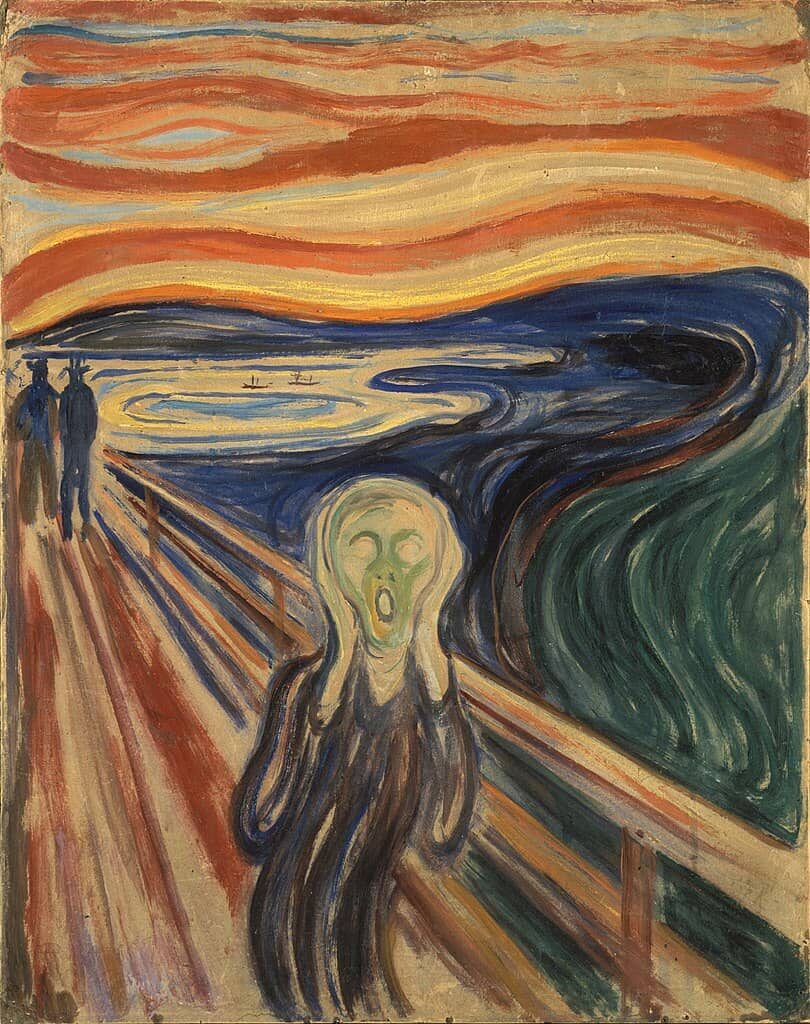
Friedrich Nietzsche argued that truth is “a movable host of metaphors, metonymies, and anthropomorphisms” (Nietzsche 878). He insists that language is nothing more than metaphors lost in translation, and what we call “truth” is an illusion that humans create since proving its originality is unattainable. We appear to know the meaning of words - the tree, the snow, or the flower - but our knowledge is merely a metaphor for what they are (Nietzsche 877). His epistemological argument, that the conceptual way of life we live is a human fabrication rather than a faithful mirror of reality, is striking in Edvard Munch’s The Scream. This idea, where Nietzsche challenges the assumption that perception gives us direct access to reality, is epitomized in Munch’s representation of external world objectivity, transforming the landscape into a visual expression of inner psychological experience.
Munch described the painting’s origin as a moment of sensory overwhelm: walking at dusk, he felt the sky turn to blood and nature begin to scream (Zaczek). What he recorded was not the same landscape that appeared to his companions, but the raw nerve stimulus before it evolved into stable metaphors we now know as “sky,” “evening,” or “fjord” (Nietzsche 877). Munch distorts the sky, water, and bridge into undulating, almost violent lines, suggesting what we see is inseparable from how we feel (Munch). The swirling amber sky does not correspond to any naturalistic observation; it echoes Nietzsche’s idea that “truth” is a constructed representation, where the “truth” of the sky is not the sky itself but a sensation delivered before language could domesticate it into a familiar designation (Nietzsche 881). The central figure, its face dissolved into a hollow oval of anguish, has lost what Nietzsche identifies as the “proud, deceptive consciousness” that ordinarily shields humans from the chaos beneath perception (Munch).
Nietzsche warns if a person could “peer out and down through a crack in the chamber of consciousness,” he would suspect that beneath the reassuring edifice of concepts and language, existence is pitiless (Nietzsche 875). The Scream paints that exact cracking. The scene collapses the distinction between self and world, the scream reverberating through the composition and ambiguating the boundaries between subject and object. It is then that the figure cannot impose order on perception. While Nietzsche asserts in philosophy that truths are illusions we have forgotten are illusions, Munch conveys in art the instant when that forgetting fails: when metaphors give way and sensations flood instantaneously.
Works Cited
Munch, Edvard. The Scream. 1893, National Museum of Norway, Oslo. Oil, tempera, and pastel on cardboard.
Nietzsche, Friedrich. On Truth and Lies in a Nonmoral Sense. Compiled by David Fox, 1873.
Zaczek, Iain. "The Scream." Britannica. 2 Mar. 2026. Accessed 8 Apr. 2026.